

St. Patrick Snakes Metaphor for Pagans: Meaning, History and Symbolism
MetaphorCraftz.com >> Uncategorized>> St. Patrick Snakes Metaphor for Pagans: Meaning, History and Symbolism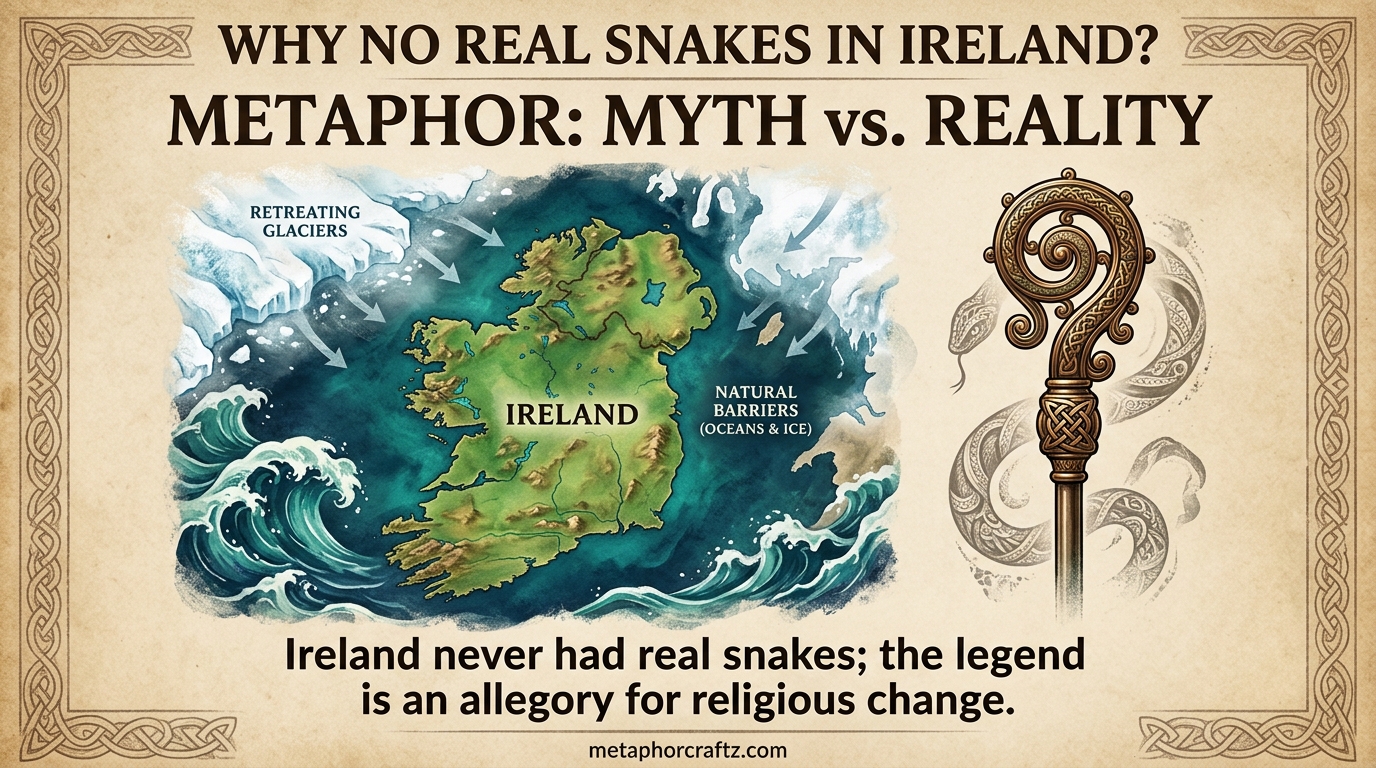
St. Patrick Snakes Metaphor for Pagans: Meaning, History and Symbolism
The story of St. Patrick driving snakes out of Ireland is one of the most famous legends in Irish history. But what does it mean when people use this story as a metaphor for pagans?
In simple terms, the snakes are often seen as symbols of pagan beliefs, old religious customs, or spiritual practices that existed in Ireland before Christianity spread across the island.
In this interpretation, St. Patrick represents the Christian faith, while the removal of the snakes represents the growth of Christianity and the decline of some older traditions.
However, there is an important detail to understand. Ireland has no native snake population, and there is no reliable historical evidence that St. Patrick literally drove snakes out of the country.
Many historians and writers view the story as a religious legend that developed symbolic meaning over time.
People search for this metaphor when studying Irish folklore, Christian history, pagan traditions, or the relationship between old and new religions.
It can also appear in discussions about religious change, cultural identity, and the way stories shape public beliefs.
This guide, updated for 2026, explains the metaphor in simple English, explores its historical background, and shows how to discuss its meaning without confusing legend with fact or treating all pagan traditions as the same.
Definition & Meaning

The phrase “St. Patrick snakes metaphor for pagans” refers to the interpretation that the snakes in the Irish saint’s famous legend represent pagan beliefs or spiritual practices, while St. Patrick represents the spread of Christianity. This is a symbolic reading of the story, not proof that the legend originally had that meaning.
Simple definition
- St. Patrick: A Christian missionary closely linked to the spread of Christianity in Ireland.
- Snakes: Creatures in the legend that can symbolize evil, paganism, or spiritual opposition in a Christian interpretation.
- Driving out the snakes: A symbolic way to describe the removal or decline of older religious beliefs.
- Pagans: People who followed pre-Christian religious traditions; the term covers many different beliefs and practices.
Quick explanation
Imagine a story in which a religious teacher drives dangerous creatures out of a land. A Christian reader might understand the creatures as symbols of beliefs the teacher considers spiritually harmful.
Applied to St. Patrick, this interpretation presents the saint as a figure of Christian change and the snakes as symbols of the older religious world. However, the snake story appears in medieval accounts written centuries after Patrick lived, and the surviving evidence does not establish that the snakes were originally intended to represent pagans.
Summary table
| Part of the story | Possible symbolic meaning |
|---|---|
| St. Patrick | Christianity and Christian missionary work |
| Snakes | Evil, spiritual danger, or paganism in a Christian reading |
| Driving snakes away | Religious change or the decline of older beliefs |
| Ireland | The place where the story of Christian conversion unfolds |
| The sea | Separation, removal, or the end of a threat in the legend |
| The saint’s victory | The triumph of Christian faith in a religious interpretation |
These are possible interpretations, not fixed meanings shared by every historian, Christian, or pagan practitioner.
Why Do People Use the St. Patrick Snakes Metaphor for Pagans?
People discuss this metaphor to explain how the legend can represent the spread of Christianity and the loss or rejection of older religious traditions. It also helps readers explore how religious stories can express conflict between belief systems, although the metaphor should not be mistaken for a proven account of Ireland’s conversion.
1. To explain the spread of Christianity
St. Patrick is remembered for his Christian missionary work in Ireland. The snake legend can be read as a simple picture of a new faith replacing older religious customs.
2. To discuss pre-Christian Irish religion
Before Christianity became established, people in Ireland followed varied religious traditions. These traditions are often described broadly as pagan, although they were not one single religion with one shared set of beliefs.
3. To understand religious symbolism
Snakes have different meanings across cultures. In many Christian readings, the serpent is associated with temptation or evil, especially because of the story in Genesis. This makes the snake an understandable symbol of spiritual opposition within a Christian story.
4. To study folklore and legends
The story is a useful example of how legends can connect a famous person with a place, a religious message, and a memorable image. It is also a reminder that a popular story can have symbolic meaning without being a literal historical account.
5. To explore cultural change
The metaphor can raise questions about what happens when one religion becomes dominant. Some customs may disappear, change, survive in new forms, or continue alongside the newer faith.
6. To discuss religious bias
The story can also be examined from a critical point of view. If snakes stand for pagans, the legend may portray an older religious community as dangerous. That tells us something about the story’s possible Christian viewpoint, not necessarily about the people it describes.
60 Examples of the St. Patrick Snakes Metaphor for Pagans

The following examples show how writers, students, and readers might explain the legend from different angles. They are interpretive examples created for learning, not 60 traditional meanings of the story. Each one connects the snake legend with religion, history, culture, or language while keeping the difference between symbolism and historical fact clear.
A. Basic metaphor examples
1. Snakes as pagan beliefs
Meaning: The snakes represent pre-Christian religious beliefs.
Explanation: This is the most direct version of the metaphor. It presents the legend as a symbol of Christianity replacing older beliefs.
Sample sentence: “In one interpretation, St. Patrick’s snakes represent pagan beliefs in Ireland.”
Use / Avoid: Use when explaining the symbolic reading; avoid claiming it is the proven original meaning.
Alternatives: Older religious beliefs; pre-Christian traditions; pagan practices.
Difficulty: Easy · Tone: Neutral
2. Snakes as spiritual opposition
Meaning: The snakes represent forces seen as opposing Christian faith.
Explanation: A Christian storyteller might present the saint’s victory as a victory over spiritual opposition.
Sample sentence: “The snakes can symbolize spiritual opposition in a Christian reading.”
Use / Avoid: Use in religious analysis; avoid treating all pagans as enemies of Christians.
Alternatives: Religious conflict; spiritual struggle; opposition to faith.
Difficulty: Easy · Tone: Neutral
3. Snakes as evil
Meaning: The snakes represent evil or danger.
Explanation: Some Christian interpretations connect snakes with the serpent in Genesis, where the serpent tempts Eve.
Sample sentence: “The snakes may represent evil in the legend’s Christian symbolism.”
Use / Avoid: Use when discussing Christian symbols; avoid saying snakes mean evil in every culture.
Alternatives: Sin; temptation; spiritual danger.
Difficulty: Easy · Tone: Neutral
4. St. Patrick as a symbol of Christianity
Meaning: The saint represents the Christian faith.
Explanation: His role in the story can stand for the spread of Christian teaching in Ireland.
Sample sentence: “St. Patrick represents Christianity in this symbolic reading.”
Use / Avoid: Use in a history or literature essay; avoid implying he was the only person who brought Christianity to Ireland.
Alternatives: Christian mission; Christian teaching; the growth of Christianity.
Difficulty: Easy · Tone: Neutral
5. Driving out snakes as religious change
Meaning: The removal of snakes represents a change in religious belief.
Explanation: The action becomes a symbol of a society moving toward a new faith.
Sample sentence: “Driving out the snakes can represent religious change in Ireland.”
Use / Avoid: Use when comparing religions over time; avoid describing every conversion as forced.
Alternatives: Religious transition; changing beliefs; a shift in faith.
Difficulty: Easy · Tone: Neutral
6. Snakes as an old way of life
Meaning: The snakes stand for traditions that existed before Christianity.
Explanation: This reading focuses on cultural change rather than on whether the old traditions were good or bad.
Sample sentence: “The snakes may symbolize an older way of life.”
Use / Avoid: Use in cultural analysis; avoid assuming every old custom disappeared.
Alternatives: Ancient customs; inherited traditions; earlier beliefs.
Difficulty: Easy · Tone: Neutral
7. The saint’s victory as Christian success
Meaning: The victory represents the growth of Christian influence.
Explanation: The legend gives religious change a clear hero and a clear outcome.
Sample sentence: “The saint’s victory reflects the success of his Christian mission.”
Use / Avoid: Use when explaining the legend’s message; avoid treating symbolic success as proof of a specific historical event.
Alternatives: Growth of faith; Christian influence; missionary success.
Difficulty: Easy · Tone: Neutral
8. Ireland as a changing religious landscape
Meaning: Ireland represents a place experiencing religious change.
Explanation: The land becomes more than a setting; it represents a community whose beliefs develop over time.
Sample sentence: “Ireland serves as the setting for a story about religious change.”
Use / Avoid: Use in an essay; avoid suggesting every region or community changed at the same pace.
Alternatives: Religious landscape; changing society; cultural setting.
Difficulty: Medium · Tone: Neutral
9. The sea as separation
Meaning: The sea represents separation from something unwanted.
Explanation: In the legend, the snakes are sent away from the land and into the water.
Sample sentence: “The sea can symbolize separation from the old religious order.”
Use / Avoid: Use as a literary interpretation; avoid presenting it as a fixed traditional meaning.
Alternatives: Distance; removal; a dividing line.
Difficulty: Medium · Tone: Neutral
10. The legend as a picture of conversion
Meaning: The story represents people changing their religion.
Explanation: The removal of snakes becomes a dramatic image for the spread of Christianity.
Sample sentence: “The legend can be read as a picture of Ireland’s Christianization.”
Use / Avoid: Use in historical discussion; avoid assuming all Irish people converted at once.
Alternatives: Religious conversion; change of faith; Christianization.
Difficulty: Medium · Tone: Formal
B. Examples about pagan traditions and cultural change
11. Snakes as older sacred symbols
Meaning: The snakes represent religious symbols associated with an earlier culture.
Explanation: Serpents appear in many ancient belief systems, but their meanings differ. This interpretation is possible without claiming all Irish pagans worshiped snakes.
Sample sentence: “The snake may recall older sacred symbols.”
Use / Avoid: Use when discussing symbolism; avoid claiming every pagan tradition treated snakes as sacred.
Alternatives: Ancient symbols; sacred imagery; traditional emblems.
Difficulty: Medium · Tone: Neutral
12. Snakes as the old religious order
Meaning: The snakes represent a religious system that loses influence.
Explanation: The metaphor focuses on a shift in power between belief systems.
Sample sentence: “The banished snakes can symbolize the decline of an older religious order.”
Use / Avoid: Use in historical interpretation; avoid assuming older religions vanished completely.
Alternatives: Former belief system; older religious order; declining tradition.
Difficulty: Medium · Tone: Formal
13. Snakes as traditional rituals
Meaning: The snakes represent religious ceremonies or customs.
Explanation: The image suggests that some old practices are being rejected or replaced.
Sample sentence: “The snakes may stand for rituals that Christianity challenged.”
Use / Avoid: Use when discussing cultural change; avoid inventing specific rituals that the legend never names.
Alternatives: Religious customs; sacred ceremonies; traditional practices.
Difficulty: Medium · Tone: Neutral
14. Snakes as older spiritual authorities
Meaning: The snakes represent sources of spiritual authority outside Christianity.
Explanation: Some readers may connect the image with druids, but the story does not establish that snakes literally represent druids.
Sample sentence: “Some modern readers connect the legend with the decline of older spiritual authority.”
Use / Avoid: Use with a clear qualification; avoid calling all druids evil.
Alternatives: Religious leadership; spiritual authority; traditional teachers.
Difficulty: Hard · Tone: Formal
15. The legend as a story of cultural transition
Meaning: The story represents a society moving from one religious era to another.
Explanation: This reading places the emphasis on change rather than on a battle between good and evil.
Sample sentence: “The legend reflects a transition in Ireland’s religious culture.”
Use / Avoid: Use in balanced essays; avoid presenting the metaphor as a complete history of Ireland.
Alternatives: Cultural transition; historical change; religious development.
Difficulty: Medium · Tone: Formal
16. Snakes as beliefs labeled dangerous
Meaning: The snakes represent beliefs that a Christian narrator views as harmful.
Explanation: The metaphor reveals the narrator’s point of view, which may not match how practitioners of the older faith understood their beliefs.
Sample sentence: “The snakes symbolize beliefs that the Christian storyteller rejects.”
Use / Avoid: Use in critical reading; avoid treating the narrator’s judgment as a neutral fact.
Alternatives: Rejected beliefs; contested traditions; beliefs seen as threatening.
Difficulty: Hard · Tone: Formal
17. The legend as a sign of Christian identity
Meaning: The story helps express what a Christian community believes about its past.
Explanation: A legend can strengthen group identity by showing a saint overcoming a symbolic threat.
Sample sentence: “The snake story became part of the way people told Ireland’s Christian past.”
Use / Avoid: Use in folklore studies; avoid assuming every Christian interprets the story in the same way.
Alternatives: Religious identity; shared memory; community tradition.
Difficulty: Medium · Tone: Neutral
18. Snakes as resistance to change
Meaning: The snakes represent resistance to a new religious order.
Explanation: This is a possible modern literary reading, not a documented original explanation.
Sample sentence: “A writer might use the snakes to represent resistance to religious change.”
Use / Avoid: Use in creative writing; avoid claiming historical pagans all resisted Christianity.
Alternatives: Resistance; opposition; reluctance to change.
Difficulty: Medium · Tone: Neutral
19. The story as a conflict between belief systems
Meaning: The legend symbolizes tension between different religions.
Explanation: It can help readers discuss how communities describe beliefs that differ from their own.
Sample sentence: “The legend can be read as a symbolic conflict between religious traditions.”
Use / Avoid: Use in comparative religion; avoid reducing every historical interaction to conflict.
Alternatives: Religious tension; belief-system conflict; spiritual disagreement.
Difficulty: Medium · Tone: Formal
20. Snakes as a past being left behind
Meaning: The snakes represent traditions that a community is said to have left behind.
Explanation: The image of removal creates a sharp contrast between the past and the present.
Sample sentence: “The banishment can symbolize leaving an older religious era behind.”
Use / Avoid: Use as an interpretive metaphor; avoid claiming older customs disappeared altogether.
Alternatives: A fading past; abandoned customs; a new era.
Difficulty: Easy · Tone: Neutral
C. Examples for history and folklore essays
21. The legend as religious storytelling
Meaning: The story uses a dramatic event to communicate a religious message.
Explanation: The saint’s victory makes a complex historical process easy to remember.
Sample sentence: “The snake legend uses religious storytelling to explain Christian influence.”
Use / Avoid: Use in folklore essays; avoid confusing a story’s message with evidence.
Alternatives: Sacred storytelling; religious legend; symbolic narrative.
Difficulty: Medium · Tone: Formal
22. Snakes as a symbol of spiritual danger
Meaning: The snakes stand for a danger to the soul in a Christian worldview.
Explanation: This interpretation draws on Christian ideas about temptation and sin.
Sample sentence: “The snakes may represent spiritual danger in the saint’s legend.”
Use / Avoid: Use when explaining a Christian viewpoint; avoid applying this meaning to all cultures.
Alternatives: Moral danger; spiritual threat; temptation.
Difficulty: Easy · Tone: Neutral
23. The story as a miracle narrative
Meaning: The legend presents the saint as performing a supernatural act.
Explanation: Within the story, the miracle demonstrates his special spiritual power.
Sample sentence: “The banishment of snakes is told as a miracle in the legend.”
Use / Avoid: Use to describe the story; avoid presenting the miracle as scientifically verified.
Alternatives: Sacred tale; miraculous episode; saint’s legend.
Difficulty: Easy · Tone: Neutral
24. The legend as a symbolic explanation of nature
Meaning: The story offers a religious explanation for a natural feature of Ireland.
Explanation: Legends sometimes explain why a place seems unusual, even when science provides another answer.
Sample sentence: “The legend offers a mythical explanation for Ireland’s lack of native snakes.”
Use / Avoid: Use in folklore analysis; avoid presenting folklore as zoological evidence.
Alternatives: Origin legend; traditional explanation; mythical account.
Difficulty: Medium · Tone: Neutral
25. Snakes as a sign of a defeated enemy
Meaning: The snakes symbolize an opponent overcome by the hero.
Explanation: The story follows a familiar narrative pattern in which a saint defeats a threatening creature.
Sample sentence: “The snakes serve as the saint’s symbolic opponents.”
Use / Avoid: Use in story analysis; avoid assuming the snakes represent one specific historical group.
Alternatives: Defeated enemy; opposing force; conquered threat.
Difficulty: Easy · Tone: Neutral
26. St. Patrick as a religious hero
Meaning: The saint represents courage and devotion to faith.
Explanation: The legend presents him as a figure who overcomes danger through spiritual power.
Sample sentence: “The snake story presents St. Patrick as a religious hero.”
Use / Avoid: Use in literary analysis; avoid confusing legendary events with confirmed biography.
Alternatives: Holy figure; spiritual champion; Christian hero.
Difficulty: Easy · Tone: Neutral
27. The legend as a medieval worldview
Meaning: The story reflects ideas that medieval Christian writers used to explain holiness and evil.
Explanation: Its later written forms can tell us about medieval religious imagination, even when they do not establish what happened in the fifth century.
Sample sentence: “The legend reveals aspects of medieval Christian storytelling.”
Use / Avoid: Use in historical analysis; avoid treating medieval writing as direct eyewitness evidence.
Alternatives: Medieval belief; religious worldview; historical imagination.
Difficulty: Hard · Tone: Formal
28. The legend as a cultural memory
Meaning: The story helps later generations remember a religious past.
Explanation: Repeated retellings can make a legend part of a community’s shared history.
Sample sentence: “The snake legend remains part of Ireland’s cultural memory.”
Use / Avoid: Use in cultural studies; avoid assuming every version has the same message.
Alternatives: Shared memory; inherited story; cultural tradition.
Difficulty: Medium · Tone: Formal
29. The legend as a story of religious authority
Meaning: The saint’s power symbolizes the authority of Christianity.
Explanation: The story places the saint in control of creatures that threaten the land.
Sample sentence: “The legend presents St. Patrick as a figure of Christian authority.”
Use / Avoid: Use in religious history; avoid assuming that the story accurately records political power.
Alternatives: Religious leadership; spiritual authority; sacred power.
Difficulty: Medium · Tone: Formal
30. The legend as an example of mythmaking
Meaning: A story grows around a famous person and becomes part of popular tradition.
Explanation: The snake tale is recorded in medieval accounts long after Patrick’s lifetime, showing how stories about saints could develop over time.
Sample sentence: “The legend shows how later generations can shape stories about a famous saint.”
Use / Avoid: Use in folklore studies; avoid using “myth” to mean that a community’s beliefs are foolish.
Alternatives: Legend-building; folklore development; cultural storytelling.
Difficulty: Hard · Tone: Formal
D. Examples for critical thinking and religious comparison
31. The snakes as an outsider’s label
Meaning: The snakes represent how one religious group describes another.
Explanation: A story may portray unfamiliar beliefs as dangerous because of the narrator’s point of view.
Sample sentence: “The snake metaphor may show how a religious group viewed its rivals.”
Use / Avoid: Use in critical analysis; avoid assuming this was the only Christian view.
Alternatives: Outsider’s view; religious labeling; cultural judgment.
Difficulty: Hard · Tone: Formal
32. The legend as a story of religious replacement
Meaning: One faith replaces or becomes dominant over another.
Explanation: The image of expulsion presents change as a clean break, although real religious history is usually more complex.
Sample sentence: “The legend can symbolize the replacement of older religious customs.”
Use / Avoid: Use in broad interpretation; avoid assuming total replacement occurred everywhere.
Alternatives: Religious succession; change of faith; cultural shift.
Difficulty: Medium · Tone: Neutral
33. Snakes as a symbol of feared beliefs
Meaning: The snakes represent beliefs viewed with fear or suspicion.
Explanation: This reading focuses on the emotions behind a story rather than on the truth of the claims.
Sample sentence: “The snakes may symbolize religious ideas that the storyteller feared.”
Use / Avoid: Use in a critical essay; avoid claiming the entire community felt this way.
Alternatives: Feared customs; suspicious beliefs; religious anxiety.
Difficulty: Hard · Tone: Formal
34. The legend as a lesson about power
Meaning: The story shows how a powerful religious figure defeats a threat.
Explanation: The saint’s victory can be examined as a narrative about who has the right to define spiritual truth.
Sample sentence: “The legend can raise questions about religious power and authority.”
Use / Avoid: Use in literary criticism; avoid claiming the tale alone proves historical oppression.
Alternatives: Religious power; authority; control over belief.
Difficulty: Hard · Tone: Formal
35. The metaphor as a one-sided account
Meaning: The story may present only the winning side’s view of religious change.
Explanation: A tale centered on a Christian saint may not explain how pre-Christian people understood their own traditions.
Sample sentence: “The legend gives a Christian-centered view of Ireland’s religious past.”
Use / Avoid: Use in balanced historical writing; avoid dismissing the story’s cultural value.
Alternatives: One-sided narrative; partial account; single viewpoint.
Difficulty: Hard · Tone: Formal
36. The story as a reminder of lost traditions
Meaning: The metaphor draws attention to beliefs that became less visible over time.
Explanation: It can prompt questions about customs that survived, changed, or disappeared as Christianity spread.
Sample sentence: “The legend invites us to ask what happened to older Irish traditions.”
Use / Avoid: Use in cultural history; avoid assuming all traditions were lost.
Alternatives: Forgotten customs; cultural loss; fading traditions.
Difficulty: Medium · Tone: Neutral
37. The legend as a meeting of cultures
Meaning: The story represents an encounter between different religious worlds.
Explanation: It can open a discussion about how beliefs interact when new religious ideas arrive.
Sample sentence: “The snake legend can be used to discuss encounters between religious cultures.”
Use / Avoid: Use in comparative studies; avoid assuming that all encounters involved violence.
Alternatives: Cultural encounter; religious exchange; meeting of traditions.
Difficulty: Medium · Tone: Neutral
38. The metaphor as a symbol of intolerance
Meaning: The snakes may represent a tradition portrayed as something that must be removed.
Explanation: Modern readers may question the idea that a different religion should be treated as a threat.
Sample sentence: “A critical reading might see the metaphor as a warning about religious intolerance.”
Use / Avoid: Use when analyzing attitudes; avoid claiming this interpretation is the legend’s settled meaning.
Alternatives: Religious intolerance; exclusion; rejection of difference.
Difficulty: Hard · Tone: Formal
39. The story as a symbol of conviction
Meaning: St. Patrick represents strong commitment to his faith.
Explanation: The saint’s role can be read as a picture of dedication to religious teaching.
Sample sentence: “The legend presents Patrick as a man devoted to his Christian mission.”
Use / Avoid: Use in biography or literary analysis; avoid claiming every detail is historically verified.
Alternatives: Faithfulness; dedication; strong belief.
Difficulty: Easy · Tone: Neutral
40. The metaphor as a debate about historical memory
Meaning: The story raises questions about how communities remember their past.
Explanation: A popular legend can influence public understanding even when evidence challenges its literal details.
Sample sentence: “The snake legend shows how folklore can shape historical memory.”
Use / Avoid: Use in history essays; avoid treating popularity as proof.
Alternatives: Historical memory; shared past; public remembrance.
Difficulty: Medium · Tone: Formal
E. Examples for school, writing, and discussion
41. A simple classroom metaphor
Meaning: The snakes represent old beliefs, and Patrick represents Christianity.
Explanation: This short version helps young students understand the main symbolic reading.
Sample sentence: “The snakes stand for pagan beliefs in one interpretation of the legend.”
Use / Avoid: Use for a basic school answer; avoid calling it a proven fact.
Alternatives: Old beliefs; older traditions; pre-Christian religion.
Difficulty: Easy · Tone: Neutral
42. A history essay interpretation
Meaning: The story may symbolize the spread of Christianity in Ireland.
Explanation: This version links the legend with the broad historical process of Christianization.
Sample sentence: “The snake legend is often interpreted as a metaphor for Christianization.”
Use / Avoid: Use in a history essay; avoid treating the legend as a direct historical record.
Alternatives: Spread of Christianity; religious change; Christian influence.
Difficulty: Medium · Tone: Formal
43. A literature essay interpretation
Meaning: The snakes function as symbols rather than ordinary animals.
Explanation: Literary analysis asks what an image means within a story and how it supports the theme.
Sample sentence: “The snakes function as symbols of spiritual opposition in the legend.”
Use / Avoid: Use in literary analysis; avoid asserting a single meaning without evidence.
Alternatives: Symbolic image; literary symbol; figurative meaning.
Difficulty: Medium · Tone: Formal
44. A religious studies interpretation
Meaning: The legend reflects a Christian understanding of religious victory.
Explanation: The story can be studied as an expression of belief without requiring every reader to accept it literally.
Sample sentence: “The legend expresses a Christian view of spiritual victory.”
Use / Avoid: Use in religious studies; avoid presenting one interpretation as the view of all Christians.
Alternatives: Religious viewpoint; Christian symbolism; spiritual victory.
Difficulty: Medium · Tone: Formal
45. A balanced classroom discussion
Meaning: The legend has religious significance, but its literal claim lacks historical support.
Explanation: Students can respect a story’s cultural importance while asking what the evidence shows.
Sample sentence: “The legend is meaningful to many people, but it is not a verified account of snake removal.”
Use / Avoid: Use in evidence-based discussion; avoid mocking religious traditions.
Alternatives: Critical reading; balanced interpretation; evidence-based view.
Difficulty: Medium · Tone: Neutral
46. A debate about paganism
Meaning: The story can open a discussion about how pagan traditions are represented.
Explanation: It allows students to compare the storyteller’s view with what is known about pre-Christian religions.
Sample sentence: “The legend raises questions about how Christian writers portrayed pagan traditions.”
Use / Avoid: Use in respectful debate; avoid treating paganism as one uniform faith.
Alternatives: Religious representation; cultural viewpoint; historical interpretation.
Difficulty: Hard · Tone: Formal
47. A short social media explanation
Meaning: The snake story is sometimes read as a symbol of Christianity replacing pagan beliefs.
Explanation: A short post can explain the interpretation while noting that it is symbolic.
Sample sentence: “The St. Patrick snake legend may symbolize Christianization, not a real event involving snakes.”
Use / Avoid: Use in an educational post; avoid presenting speculation as settled history.
Alternatives: Symbolic reading; folklore interpretation; historical legend.
Difficulty: Easy · Tone: Informal
48. A book discussion interpretation
Meaning: The legend can be understood as a story about faith and cultural change.
Explanation: Readers can discuss both the religious message and the story’s historical setting.
Sample sentence: “The legend combines Christian belief with Irish cultural memory.”
Use / Avoid: Use in a book club; avoid assuming every reader shares the same faith.
Alternatives: Cultural memory; religious storytelling; historical folklore.
Difficulty: Medium · Tone: Neutral
49. A museum interpretation
Meaning: The story shows how folklore becomes part of a place’s identity.
Explanation: Museums can use the legend to explain the relationship between history, art, belief, and popular tradition.
Sample sentence: “The snake legend remains a recognizable part of St. Patrick’s popular image.”
Use / Avoid: Use in heritage writing; avoid labeling folklore as historical proof.
Alternatives: Cultural heritage; popular tradition; historical folklore.
Difficulty: Medium · Tone: Formal
50. A respectful interfaith interpretation
Meaning: The legend shows how one faith may describe the decline of another.
Explanation: This interpretation encourages people to understand religious differences without insulting either group.
Sample sentence: “The story offers a chance to discuss religious change with respect for different traditions.”
Use / Avoid: Use in interfaith dialogue; avoid using the metaphor to demean pagans.
Alternatives: Interfaith understanding; religious diversity; respectful dialogue.
Difficulty: Medium · Tone: Neutral
F. More advanced symbolic interpretations
51. Snakes as a symbol of temptation
Meaning: The snakes represent temptation or the pull toward sin.
Explanation: This reading draws on the serpent’s role in the biblical story of Adam and Eve.
Sample sentence: “The snakes may symbolize temptation in a Christian interpretation.”
Use / Avoid: Use when discussing biblical imagery; avoid claiming that all serpent symbols mean temptation.
Alternatives: Temptation; moral struggle; spiritual testing.
Difficulty: Medium · Tone: Neutral
52. Snakes as a symbol of spiritual disorder
Meaning: The snakes represent a world the storyteller sees as spiritually out of order.
Explanation: The saint’s act restores order within the legend’s religious framework.
Sample sentence: “The snakes can represent spiritual disorder in the story.”
Use / Avoid: Use in literary analysis; avoid presenting a Christian judgment as a neutral description of pagan life.
Alternatives: Spiritual confusion; disorder; religious tension.
Difficulty: Hard · Tone: Formal
53. The saint’s act as purification
Meaning: Removing the snakes symbolizes cleansing the land.
Explanation: In this reading, the story presents Ireland as becoming spiritually pure through the saint’s action.
Sample sentence: “The banishment may symbolize spiritual purification in the legend.”
Use / Avoid: Use when discussing the story’s religious imagery; avoid suggesting that real communities were impure.
Alternatives: Spiritual cleansing; purification; renewal.
Difficulty: Hard · Tone: Formal
54. The story as a symbol of renewal
Meaning: The removal of snakes represents a new beginning.
Explanation: A threatening presence disappears, allowing the story to present the land as renewed.
Sample sentence: “The legend can be interpreted as a story of religious renewal.”
Use / Avoid: Use in symbolic writing; avoid claiming renewal was the legend’s original purpose.
Alternatives: New beginning; renewal; transformation.
Difficulty: Medium · Tone: Neutral
55. The story as a symbol of certainty
Meaning: The saint’s victory represents confidence in a religious truth.
Explanation: The simple ending gives the story a clear moral direction.
Sample sentence: “The legend presents Christian faith as a source of certainty.”
Use / Avoid: Use in literary discussion; avoid assuming that every historical Christian experienced faith in the same way.
Alternatives: Conviction; certainty; confidence in faith.
Difficulty: Medium · Tone: Neutral
56. The snakes as a symbol of fear of the unknown
Meaning: The snakes represent something unfamiliar that a community fears.
Explanation: This modern interpretation focuses on how stories can turn uncertainty into a visible enemy.
Sample sentence: “The snakes could symbolize fear of unfamiliar beliefs.”
Use / Avoid: Use as a critical or creative reading; avoid claiming it is a documented historical meaning.
Alternatives: Fear of difference; uncertainty; suspicion of the unknown.
Difficulty: Hard · Tone: Neutral
57. The story as a symbol of transformation
Meaning: The legend represents a major change in a society’s identity.
Explanation: The story turns a long historical process into one memorable action.
Sample sentence: “The snake legend can symbolize Ireland’s religious transformation.”
Use / Avoid: Use in broad cultural analysis; avoid claiming the process was simple or complete.
Alternatives: Transformation; transition; social change.
Difficulty: Medium · Tone: Formal
58. The story as a symbol of survival
Meaning: Older traditions may survive even when a new religion becomes dominant.
Explanation: This interpretation challenges the image of total removal and encourages readers to look for cultural continuity.
Sample sentence: “Although the legend describes removal, older customs may survive through cultural change.”
Use / Avoid: Use in nuanced historical discussion; avoid claiming that any particular custom survived without evidence.
Alternatives: Cultural continuity; persistence of tradition; survival of customs.
Difficulty: Hard · Tone: Formal
59. The story as a symbol of competing memories
Meaning: Different communities may remember religious change in different ways.
Explanation: A Christian legend, a modern historical account, and a pagan perspective may tell different stories about the same broad period.
Sample sentence: “The snake legend shows how the past can be remembered from different viewpoints.”
Use / Avoid: Use in cultural studies; avoid assuming every member of a group shares one view.
Alternatives: Competing narratives; different memories; multiple perspectives.
Difficulty: Hard · Tone: Formal
60. The story as a lesson about evidence
Meaning: The legend teaches readers to separate symbolic meaning from historical fact.
Explanation: A story can be important to culture and religion even when its literal details are not supported by evidence.
Sample sentence: “The St. Patrick legend reminds us to distinguish folklore from verified history.”
Use / Avoid: Use in research and classroom work; avoid assuming that historical analysis removes all cultural meaning.
Alternatives: Critical thinking; historical evidence; fact versus legend.
Difficulty: Medium · Tone: Neutral
Real-Life Conversations
People usually discuss the St. Patrick snake metaphor in history classes, conversations about religion, and online debates about pagan traditions. The examples below show how to explain the symbolism naturally, ask questions, and disagree respectfully without confusing a possible interpretation with established historical fact.
Conversation 1: Two friends discussing St. Patrick’s Day
Alex: Why do people say St. Patrick drove all the snakes out of Ireland?
Mia: It’s a famous legend, but Ireland didn’t have a native snake population for him to remove.
Alex: Then why do people connect the story with pagans?
Mia: Some people interpret the snakes as symbols of pagan beliefs that Christianity replaced.
Alex: So the snakes aren’t necessarily real in the story?
Mia: Right. The legend can have symbolic meaning even though the literal event isn’t supported by evidence.
Conversation 2: A student asks a history teacher
Student: Does the snake story prove that St. Patrick defeated the druids?
Teacher: No. It is sometimes interpreted as a symbol of Christianity replacing older religious traditions, but it doesn’t prove a specific event involving druids.
Student: Then can I mention paganism in my essay?
Teacher: Yes. Explain that it is one interpretation, and separate it from what historians can verify.
Student: So I should discuss both the legend and the historical evidence?
Teacher: Exactly. That makes your answer more accurate and thoughtful.
Conversation 3: A family conversation
Parent: What did you learn about St. Patrick today?
Child: He supposedly chased snakes out of Ireland.
Parent: That’s the famous story. Did you learn why some people think the snakes represent paganism?
Child: Because they think the snakes stand for the old religion?
Parent: Yes, that’s one possible symbolic meaning. But we should remember that people who followed older religions had their own beliefs and traditions.
Child: So the story is about religion as well as snakes?
Parent: Exactly.
Conversation 4: An online discussion about pagan traditions
Jordan: I read that St. Patrick drove paganism out of Ireland by removing the snakes.
Casey: That’s a common interpretation, but the story doesn’t prove that paganism disappeared.
Jordan: What do you mean?
Casey: Religious change takes time. Traditions can disappear, change, or continue in new forms.
Jordan: So it’s better to call the snake story a metaphor?
Casey: Yes, as long as we explain that it’s an interpretation rather than a confirmed original meaning.
Conversation 5: Two students preparing an essay
Sam: My essay title is “St. Patrick’s Snakes and Paganism.” What should my main point be?
Riley: You could explain that the snakes are often interpreted as symbols of pre-Christian beliefs.
Sam: Should I say that St. Patrick actually drove them away?
Riley: No. Explain that the legend developed later and that Ireland had no native snakes.
Sam: And I should mention that paganism included different traditions?
Riley: Yes. That will make your essay more respectful and historically balanced.
Everyday Usage
The phrase is most useful when discussing Irish folklore, religious symbolism, or the history of Christianity in Ireland. It is not a common everyday English idiom with one fixed definition. People usually use it in explanations, essays, discussions, and online posts about the meaning of the legend.
1. In everyday conversation
Use simple language to explain the possible meaning.
- “Some people see St. Patrick’s snakes as a metaphor for pagan beliefs.”
- “The story may symbolize the spread of Christianity.”
- “The legend is famous, but the snakes were not part of Ireland’s native wildlife.”
2. In writing and essays
A school or college essay should separate interpretation from historical fact.
Example:
“The legend of St. Patrick driving snakes out of Ireland is sometimes interpreted as a metaphor for the spread of Christianity and the decline of pre-Christian religious traditions. However, there is no evidence that the saint removed real snakes from Ireland.”
This wording explains the metaphor without claiming more than the evidence supports.
3. In books and historical writing
Writers may use the legend to explore how religious stories explain cultural change. A careful writer should identify the source and period of the story, then compare its symbolic meaning with historical evidence.
Example: “The snake legend presents religious change as a victory over a threatening force.”
4. In movies and documentaries
A documentary might show St. Patrick surrounded by snakes to represent the legend visually. Viewers should distinguish that artistic image from a historical reconstruction.
Example: “The scene uses snakes to symbolize the saint’s victory over spiritual opposition.”
5. In poetry and creative writing
A poet can use snakes as symbols of fear, tradition, change, or a rejected belief system. Creative writing allows more freedom, but the writer should not present a personal interpretation as a historical fact.
Example: “The old serpents vanished as a new faith crossed the land.”
6. In emails and professional communication
When writing to a teacher, researcher, or colleague, use clear, careful wording.
Example:
“I am studying the legend of St. Patrick driving snakes out of Ireland and its possible symbolic connection with pagan traditions. I would like to understand which parts of this interpretation are supported by historical evidence.”
7. On Instagram and Facebook
Social media posts often simplify the legend. A useful educational caption can be short while preserving the distinction between symbolism and history.
Example caption:
“Did St. Patrick really drive snakes out of Ireland? The famous story is a legend. Some interpret the snakes as symbols of paganism and the spread of Christianity, but that interpretation is not a proven historical fact.”
8. On X
Short posts can focus on one key fact.
Example:
“The St. Patrick snake legend is often read as a metaphor for Christianization. But Ireland had no native snakes, and the symbolic meaning should not be confused with historical proof.”
9. On LinkedIn
A professional post might use the story as an example of how legends shape cultural memory.
Example:
“The legend of St. Patrick and the snakes shows how a memorable story can express a community’s religious identity. Studying it requires both cultural understanding and careful use of historical evidence.”
10. In school assignments
For a short-answer question, students can use this response:
Question: What do the snakes in St. Patrick’s legend symbolize?
Answer: The snakes are sometimes interpreted as symbols of pagan beliefs or spiritual forces opposed to Christianity. Their removal can represent the spread of Christianity in Ireland. However, this is a symbolic interpretation of a legend, not a verified historical event.
FAQs:
Do the snakes in St. Patrick’s legend represent pagans?
Some modern interpretations treat the snakes as symbols of pagan beliefs or pre-Christian religious practices. However, surviving accounts do not prove that this was the legend’s original meaning. The story can be discussed as a metaphor without assuming that all pagans shared the same beliefs.
Did St. Patrick really drive snakes out of Ireland?
There is no reliable evidence that he did. Ireland has no native snake population, and natural history evidence indicates that snakes did not recolonize Ireland after the last Ice Age. The famous story is a legend, not a verified account of an event.
Were the snakes supposed to represent the druids?
Some people connect the legend with druids and other pre-Christian traditions. However, the claim that the snakes specifically represent druids is an interpretation, not an established fact about the story’s origin.
Did St. Patrick bring Christianity to Ireland?
St. Patrick was an important Christian missionary in Ireland, but he was not necessarily the first Christian missionary to reach the island. Historical accounts indicate that Christians were already present before his best-known missionary work.
Does paganism mean devil worship?
No. Paganism is a broad term for various religious traditions, especially those outside the major monotheistic religions in particular historical contexts. Pagan beliefs differ widely, and the term does not automatically mean devil worship or evil.
Why is St. Patrick shown with snakes?
Art and popular tradition often depict St. Patrick with snakes because of the famous legend. The image has become a recognizable symbol associated with his story, even though the literal event is not historically supported.
St. Patrick’s Confessio
+1
Is the snake metaphor disrespectful to pagans?
It can be, depending on how it is used. If the snakes are treated as symbols of evil and pagans are equated with them, the interpretation may portray a diverse set of religious traditions unfairly. A more balanced discussion distinguishes the Christian viewpoint within the legend from the beliefs of historical pagan communities.
Conclusion:
The St. Patrick snakes metaphor for pagans offers one way to interpret a famous Irish legend. In this reading, the snakes symbolize pre-Christian beliefs or spiritual forces opposed to Christianity,
while St. Patrick represents the spread of the Christian faith.
Yet the distinction between legend and history matters. There is no evidence that St. Patrick drove real snakes out of Ireland, and the idea that the snakes specifically represented pagans is an interpretation rather than a proven original meaning.
Understanding the story means looking at both its religious symbolism and its historical context.
It also means recognizing that pre-Christian Irish traditions were diverse and should not be reduced to a single image of evil.
The legend remains culturally important because it shows how stories can express religious identity, explain change, and shape the way later generations remember the past.
Discover more post:

Juliet is a passionate English language writer and literary content creator with over 5 years of experience in writing about metaphors, figurative language, literary devices, English expressions, and creative writing. As the author behind MetaphorCraftz, she is dedicated to making complex literary concepts simple, clear, and enjoyable for readers of all levels.
Related Post
Metaphor for Complaining: Creative Expressions With Meanings
metaphor for complaining is a normal part of everyday communication. We complain when something feels…
2 thoughts on “St. Patrick Snakes Metaphor for Pagans: Meaning, History and Symbolism”