

What Is A Streetcar Named Desire a Metaphor For? Meaning, Symbolism
MetaphorCraftz.com >> Uncategorized>> What Is A Streetcar Named Desire a Metaphor For? Meaning, Symbolism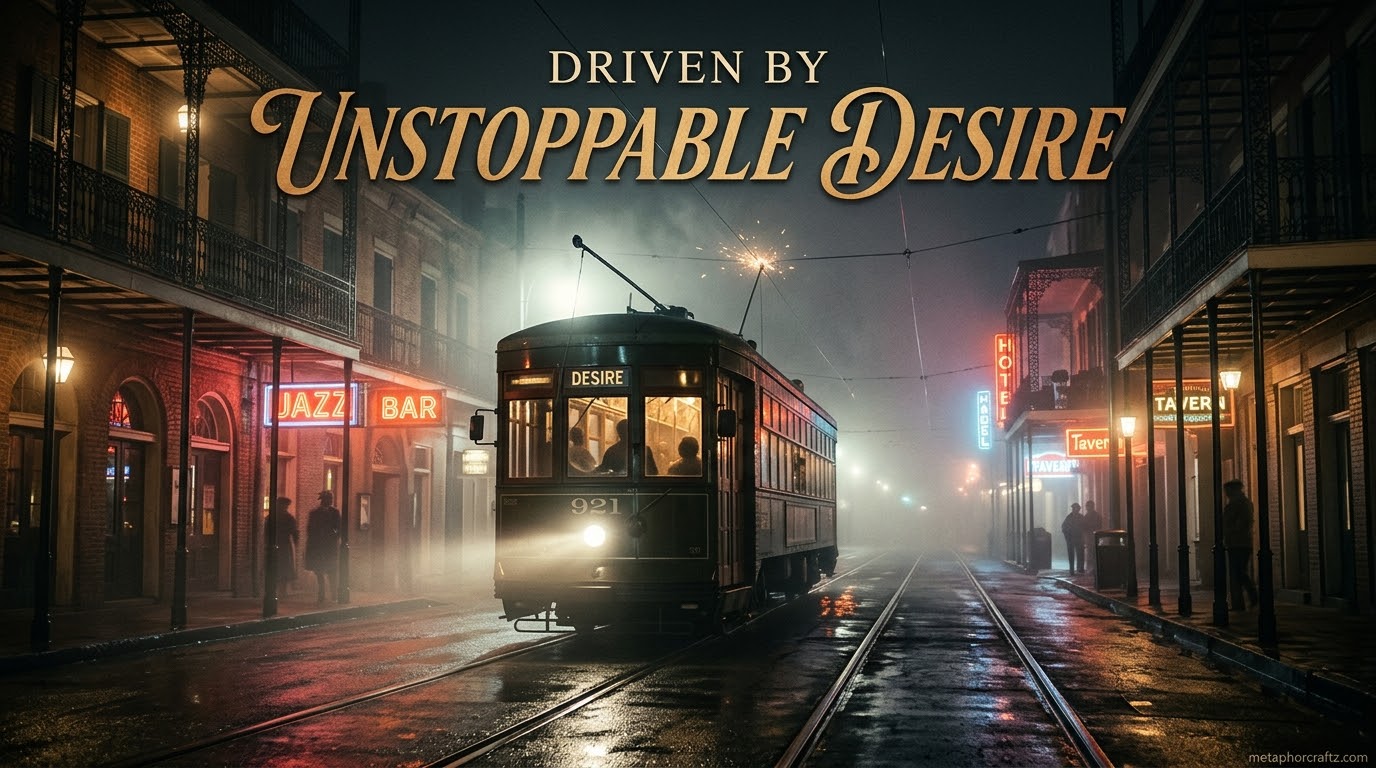
What Is A Streetcar Named Desire a Metaphor For? Meaning, Symbolism
What is A Streetcar Named Desire a metaphor for? Tennessee Williams uses the title of his famous play to show how human desire can lead people toward love, pain, destruction, and even death.
The streetcar is more than a way to travel through New Orleans. It represents the journey people take when their strongest feelings guide their choices.
The play follows Blanche DuBois, a woman who arrives in New Orleans after losing her home, her husband, and much of her former life.
Her journey takes her to her sister Stella’s home, where she faces a difficult new reality. As the story unfolds, desire, dreams, and personal struggles begin to shape the lives of everyone around her.
Many students search for the meaning of the title because its symbolism is not immediately clear. They want to know why Williams named the play after a streetcar and what the route has to do with Blanche’s tragic ending.
In this updated 2026 guide, you will learn what the title represents, how the streetcar route connects to the main themes, what the characters symbolize, and why desire becomes such a powerful force in the play.
Definition & Meaning

A Streetcar Named Desire is a metaphor for the powerful journey of human desire and the way uncontrolled passion can lead people toward suffering, loss, and destruction. Tennessee Williams uses the streetcar’s route to represent Blanche DuBois’s emotional journey from desire toward death and an uncertain new beginning.
Simple Definition
The title represents how human desires can control our lives and influence our decisions. Sometimes, the things people want most can also bring them the greatest pain.
What Does the Streetcar Symbolize?
In the play, Blanche is told to take a streetcar named Desire, transfer to one called Cemeteries, and then travel to Elysian Fields.
Each name has a deeper meaning:
- Desire: Human passion, sexual attraction, and longing.
- Cemeteries: Death, loss, and the end of the past.
- Elysian Fields: A place associated with the afterlife in Greek mythology. In the play, it is also the name of the neighborhood where Stella and Stanley live.
Blanche’s journey reflects the movement from desire through death and loss toward a new place where her past and present collide.
Quick Summary Table
| Symbol | Meaning |
|---|---|
| Streetcar named Desire | Human passion and longing |
| Cemeteries | Death, loss, and the past |
| Elysian Fields | The afterlife and a new stage of life |
| Blanche DuBois | Fragile dreams and lost innocence |
| Stanley Kowalski | Physical power and harsh reality |
| Stella Kowalski | Love, loyalty, and denial |
| Light | Truth and reality |
| Darkness | Illusion and hiding the truth |
| Paper lantern | Blanche’s desire to hide aging and reality |
| Music | Emotional memories and psychological pain |
Why Does Tennessee Williams Use This Metaphor?
Tennessee Williams uses the streetcar as a metaphor to show that desire can shape a person’s entire life. The title also gives the audience a simple way to understand Blanche’s journey. Her desires, painful memories, and attempts to escape reality gradually bring her into conflict with the world around her.
The metaphor serves several important purposes:
- To show the power of desire: People often make choices because of love, passion, or personal needs.
- To connect desire with suffering: Strong desires can sometimes bring painful consequences.
- To explore human weakness: Blanche struggles because she cannot fully accept her past or present.
- To show the conflict between dreams and reality: Blanche wants a beautiful life, but the world around her does not match her dreams.
- To create a tragic journey: The streetcar route gives the play a symbolic structure that reflects Blanche’s downfall.
Main Section: 12 Important Symbols and Metaphors in A Streetcar Named Desire

1. The Streetcar Named Desire
Meaning: Human desire and passion.
Explanation: The streetcar represents the powerful feelings that guide human choices. Blanche’s journey begins with desire, suggesting that passion can take people in directions they never expected.
Example: Blanche travels to New Orleans by following the streetcar route named Desire.
When to use this interpretation: Use it when discussing the title, the central theme, or Blanche’s emotional journey.
When NOT to use it: Do not claim that the streetcar represents only sexual desire. It also represents emotional longing and human passion.
Alternative expressions: The power of passion; the journey of desire; uncontrolled human longing.
Difficulty: Intermediate.
Tone: Neutral, literary.
2. The Streetcar Named Cemeteries
Meaning: Death, loss, and the end of the past.
Explanation: Blanche must transfer from Desire to Cemeteries. This suggests that desire can lead toward suffering, loss, and destruction. It also connects with the many deaths and losses in Blanche’s past.
Example: Blanche’s memories of her husband and the loss of Belle Reve connect her life to the idea of death.
When to use this interpretation: When explaining the tragic meaning of the streetcar route.
When NOT to use it: Do not say that the streetcar literally causes death. Its meaning is symbolic.
Alternative expressions: The end of innocence; the journey toward loss; the shadow of death.
Difficulty: Intermediate.
Tone: Formal, literary.
3. Elysian Fields
Meaning: The afterlife and a new stage of life.
Explanation: Elysian Fields refers to the home of the blessed dead in Greek mythology. Williams uses the name for the neighborhood where Stella and Stanley live. The contrast between its mythological meaning and the ordinary, troubled setting adds symbolic depth.
Example: Blanche arrives at Elysian Fields after following the streetcar route.
When to use this interpretation: When discussing the title’s full symbolic journey.
When NOT to use it: Do not describe the neighborhood as a literal paradise. The play presents a difficult and imperfect world.
Alternative expressions: The afterlife; a symbolic destination; a new beginning.
Difficulty: Advanced.
Tone: Formal, literary.
4. Blanche DuBois
Meaning: Fragile dreams, lost innocence, and the desire to escape reality.
Explanation: Blanche represents a person who struggles to accept painful truths. She creates an image of herself that is more beautiful and respectable than her real circumstances. Her behavior shows how fear and emotional pain can push someone toward illusion.
Example: Blanche tries to hide her age and past relationships from others.
When to use this interpretation: When analyzing the conflict between illusion and reality.
When NOT to use it: Do not describe Blanche as simply dishonest. Her actions are also connected to grief, trauma, and insecurity.
Alternative expressions: Fragile identity; lost innocence; escape from reality.
Difficulty: Intermediate.
Tone: Neutral, analytical.
5. Stanley Kowalski
Meaning: Physical power, realism, and control.
Explanation: Stanley represents a harsh, practical world where physical strength and authority matter. He challenges Blanche’s stories and refuses to accept the social status she tries to claim.
Example: Stanley investigates Blanche’s past and exposes information she wants to keep hidden.
When to use this interpretation: When explaining the conflict between Stanley and Blanche.
When NOT to use it: Do not suggest that Stanley represents all men or all working-class people.
Alternative expressions: Harsh reality; physical dominance; practical power.
Difficulty: Intermediate.
Tone: Neutral, analytical.
6. Stella Kowalski
Meaning: Love, loyalty, and the struggle between emotional needs and family relationships.
Explanation: Stella loves Stanley but also cares deeply about her sister. Her decisions show how difficult it can be to choose between romantic relationships and family loyalty.
Example: Stella struggles to believe Blanche’s accusations about Stanley.
When to use this interpretation: When discussing family conflict and emotional dependence.
When NOT to use it: Do not present Stella as someone who has no personal choices or feelings.
Alternative expressions: Divided loyalty; emotional attachment; family conflict.
Difficulty: Intermediate.
Tone: Neutral.
7. The Paper Lantern
Meaning: The desire to hide reality and preserve beauty.
Explanation: Blanche places a paper lantern over a bare light bulb because she dislikes harsh lighting. The lantern represents her attempt to hide her age, past, and emotional struggles.
Example: Blanche does not want Mitch to see her clearly in bright light.
When to use this interpretation: When analyzing appearance, aging, truth, and illusion.
When NOT to use it: Do not say the lantern represents beauty alone. Its deeper meaning involves Blanche’s fear of being seen as she really is.
Alternative expressions: Hiding the truth; false appearance; protection from reality.
Difficulty: Easy.
Tone: Neutral, literary.
8. Light and Darkness
Meaning: Truth and illusion.
Explanation: Light represents the harsh truth that Blanche tries to avoid. Darkness allows her to feel protected because it hides the signs of aging and the details of her past.
Example: Blanche avoids bright light because she does not want others to see her clearly.
When to use this interpretation: When discussing the play’s visual symbols and Blanche’s fear of reality.
When NOT to use it: Do not assume that every dark scene represents evil or that every bright scene represents goodness.
Alternative expressions: Truth versus illusion; exposure and concealment; reality and fantasy.
Difficulty: Easy.
Tone: Neutral.
9. The Music of the Varsouviana Polka
Meaning: Painful memories and psychological suffering.
Explanation: The polka music reminds Blanche of her young husband’s death. It returns during moments of emotional stress and connects her present experiences with her painful past.
Example: Blanche hears the music when memories of her husband’s death become overwhelming.
When to use this interpretation: When discussing memory, grief, and Blanche’s mental state.
When NOT to use it: Do not treat the music as ordinary background sound. It has a specific emotional meaning.
Alternative expressions: Traumatic memory; emotional haunting; the pain of the past.
Difficulty: Advanced.
Tone: Formal, literary.
10. Belle Reve
Meaning: Lost wealth, family history, and the disappearance of the past.
Explanation: Belle Reve is the family estate Blanche and Stella once shared. Its loss represents the collapse of their former way of life and Blanche’s struggle to accept her changed social position.
Example: Blanche tells Stella about losing Belle Reve and the deaths of family members.
When to use this interpretation: When discussing social class, family history, and loss.
When NOT to use it: Do not treat Belle Reve as simply a beautiful house. It represents an entire lost way of life.
Alternative expressions: Lost heritage; fading social status; the collapse of the past.
Difficulty: Intermediate.
Tone: Formal.
11. The Poker Night
Meaning: Male power, conflict, and the violent side of domestic life.
Explanation: The poker night brings together Stanley and his friends. Alcohol, arguments, and aggression reveal the power struggles inside the Kowalski household.
Example: Stanley becomes violent during the poker night, showing the dangerous side of his behavior.
When to use this interpretation: When analyzing gender roles, power, and violence.
When NOT to use it: Do not claim that poker itself represents violence. The symbolism comes from what happens during the scene.
Alternative expressions: Domestic conflict; male dominance; social power struggles.
Difficulty: Intermediate.
Tone: Neutral, analytical.
12. Blanche’s Final Journey
Meaning: The tragic result of her struggle with reality and emotional suffering.
Explanation: At the end of the play, Blanche is taken away to a mental institution. Her final journey reflects the collapse of her attempts to protect herself through illusion.
Example: Blanche leaves with the doctor and nurse, believing that she is going on a pleasant journey.
When to use this interpretation: When explaining the ending and the tragic meaning of the title.
When NOT to use it: Do not claim that the ending proves all desire leads to madness. The play explores a complex combination of trauma, social pressure, violence, and illusion.
Alternative expressions: Emotional collapse; tragic downfall; the loss of reality.
Difficulty: Advanced.
Tone: Formal, literary.
Quick Reference Table
| Symbol or Metaphor | Main Meaning | Connection to the Play |
|---|---|---|
| Streetcar named Desire | Human passion | Blanche’s journey begins with desire |
| Cemeteries | Death and loss | Connects with Blanche’s painful past |
| Elysian Fields | Afterlife and transition | Blanche’s destination |
| Blanche | Illusion and lost innocence | Her struggle to escape reality |
| Stanley | Power and harsh reality | His conflict with Blanche |
| Stella | Love and loyalty | Her relationship with Stanley and Blanche |
| Paper lantern | Concealing reality | Blanche hides her appearance |
| Light | Truth | Blanche fears exposure |
| Darkness | Illusion | Blanche feels safer in darkness |
| Varsouviana polka | Painful memories | Reminds Blanche of her husband |
| Belle Reve | Lost heritage | Represents her former life |
| Poker night | Conflict and male power | Reveals domestic violence |
| Final journey | Tragic downfall | Blanche leaves for institutional care |
Real-Life Conversations
These conversations show how students and readers might naturally discuss the play.
Conversation 1: Two Students Discuss the Title
Ali: Why is the play called A Streetcar Named Desire?
Sara: Because Blanche follows a streetcar route with that name when she arrives in New Orleans.
Ali: But why is it important?
Sara: The streetcar represents human desire. It shows how strong feelings can guide someone’s life.
Ali: So it is more than just transportation?
Sara: Exactly. It is a symbol of Blanche’s journey.
Conversation 2: A Student Asks a Teacher
Student: What does the streetcar named Cemeteries mean?
Teacher: It represents death, loss, and the painful experiences connected to Blanche’s past.
Student: Does it mean that desire always leads to death?
Teacher: Not exactly. Williams shows that desire can lead to painful consequences, but the play is more complex than that.
Student: I understand. It is a symbolic journey.
Conversation 3: Friends Discuss Blanche
Emma: Why does Blanche always avoid bright lights?
Jack: She does not want people to see her real appearance.
Emma: Is that connected to the paper lantern?
Jack: Yes. The lantern helps her hide from reality.
Emma: So she wants people to see the person she wishes she could be?
Jack: That’s a good way to understand her character.
Conversation 4: A Teacher Explains the Main Theme
Teacher: What is the main metaphor in the title?
Student: The streetcar represents human desire and passion.
Teacher: Good. What happens after Desire?
Student: Blanche transfers to Cemeteries and then travels to Elysian Fields.
Teacher: Correct. The route helps us understand the tragic journey at the center of the play.
Conversation 5: Students Discuss the Ending
Mia: Do you think Blanche’s ending is connected to the title?
Noah: Yes. Her journey shows how her desires, memories, and illusions affect her life.
Mia: Does she ever accept reality?
Noah: Not fully. She continues to seek comfort in her dreams and imagination.
Mia: That’s what makes the ending so sad.
Noah: Exactly.
Everyday Usage
The title and its metaphor can be discussed in different situations, especially in literature classes, essays, book discussions, and online conversations.
1. In Everyday Conversation
People may use the title when talking about passion, emotional choices, or the dangers of following strong desires.
Example:
“Her story reminds me of A Streetcar Named Desire because her emotions led her into a difficult situation.”
2. In Writing
Writers can use the play as an example of how symbols communicate deeper meanings.
Example:
“Tennessee Williams uses the streetcar route as a metaphor for the destructive power of human desire.”
3. In Books and Literature
Readers often discuss the title when analyzing symbolism, tragedy, and character development.
Example:
“The title reflects Blanche’s emotional journey from desire toward loss and suffering.”
4. In Movies and Drama
The same ideas can help explain characters who struggle between their dreams and reality.
Example:
“Like Blanche, the main character lives in an imaginary world because reality is too painful.”
5. In Poetry
The streetcar can be discussed as a symbol of emotional movement and the consequences of human longing.
Example:
“Desire becomes a road that carries the heart toward an unknown destination.”
6. In Emails
Students can use the metaphor in academic discussions with teachers.
Example:
“I believe the title represents the connection between human desire, emotional suffering, and Blanche’s tragic journey.”
7. In Text Messages
Friends can discuss the play in simple language.
Example:
“I finally understand the title! The streetcar represents desire, and the route connects to Blanche’s tragic life.”
8. On Instagram
Readers can share a short literary observation.
Example:
“Desire can take us places we never expected. A powerful lesson from A Streetcar Named Desire.”
9. On Facebook
Students and literature fans can share their interpretations.
Example:
“One of the most interesting parts of Tennessee Williams’s play is how a simple streetcar route becomes a symbol of human passion and suffering.”
10. On X
A short post can explain the central idea.
Example:
“In A Streetcar Named Desire, the streetcar route symbolizes a journey through desire, loss, and the painful struggle between dreams and reality.”
11. On LinkedIn
Teachers and literature professionals can use the play as an example of symbolic writing.
Example:
“Great literature often uses ordinary objects to communicate complex human experiences. Tennessee Williams achieves this through the symbolic streetcar route in A Streetcar Named Desire.”
12. In School Assignments
Students can use the metaphor to support an essay about the title’s meaning.
Example:
“The title A Streetcar Named Desire is a metaphor for the journey of human passion. The route from Desire through Cemeteries to Elysian Fields reflects the emotional and tragic experiences of Blanche DuBois.”
Conclusion
A Streetcar Named Desire is a metaphor for the powerful influence of human desire and the painful consequences that can follow when people struggle with their emotions and reality.
Tennessee Williams uses the streetcar route to give the play a deeper meaning. Desire represents human passion, Cemeteries represents death and loss, and Elysian Fields represents the final destination of Blanche’s journey.
The title also connects with the play’s larger themes of illusion, truth, love, power, and suffering. Blanche’s story shows how difficult it can be to face reality when the past is painful.
Ultimately, the streetcar is not just a vehicle. It is a symbol of the journey people take through life, guided by their desires and shaped by their choices.
FAQs:
1. What is A Streetcar Named Desire a metaphor for?
It is a metaphor for human desire and the way passion can lead people toward suffering, loss, and destruction. The streetcar route reflects Blanche’s tragic emotional journey.
2. What does the streetcar named Desire symbolize?
It symbolizes human passion, sexual attraction, emotional longing, and the desires that influence people’s decisions.
3. What does the streetcar named Cemeteries represent?
Cemeteries represents death, loss, and the painful experiences that shape Blanche’s past and present.
4. What does Elysian Fields symbolize?
Elysian Fields refers to the afterlife in Greek mythology. In the play, it is also the name of the neighborhood where Stella and Stanley live.
5. What is the main theme of A Streetcar Named Desire?
The main themes include desire, illusion versus reality, love, violence, social class, and the struggle between personal dreams and the real world.
6. Why does Blanche avoid bright light?
Blanche avoids bright light because she wants to hide her age and physical appearance. Light symbolizes the truth she fears facing.
7. What does the paper lantern symbolize?
The paper lantern symbolizes Blanche’s attempt to hide reality and preserve the beautiful image she has created of herself.
8. How does the title connect to Blanche’s ending?
The title reflects Blanche’s emotional journey. Her desires, painful memories, and inability to accept reality contribute to her tragic ending.
9. Is A Streetcar Named Desire an example of symbolism?
Yes. The streetcar route, light, darkness, paper lantern, music, and other elements carry meanings beyond their literal roles.
10. What is the message of A Streetcar Named Desire?
The play explores how human desire, painful memories, social pressures, and the struggle between illusion and reality can shape people’s lives. It also asks audiences to consider the importance of compassion toward vulnerable people.
Conclusion:
A Streetcar Named Desire is a powerful metaphor for human desire and the difficult journey people experience when passion, dreams, and reality come together.
Tennessee Williams uses the streetcar route to show how desire can lead to loss, suffering, and unexpected consequences.
The journey from Desire to Cemeteries and then Elysian Fields gives the title a deeper meaning. It connects with Blanche DuBois’s life, her painful memories, and her struggle to escape reality.
Other symbols, such as the paper lantern, light, darkness, and the Varsouviana polka, make the play’s message even stronger.
Ultimately, the play reminds readers that human desires can shape our choices, but escaping reality can make life even more painful.
Blanche’s tragic story helps us understand the difference between the world we wish to live in and the world we must face.
Discover more post:
| https://metaphorcraftz.com/st-patrick-snakes-metaphor-for-pagans/ |
| https://metaphorcraftz.com/metaphor-for-red-eyes/ |
| https://metaphorcraftz.com/metaphor-for-calming-down/ |

Vivienne is a passionate English language writer, literary enthusiast, and content creator with over 5 years of experience in writing about metaphors, figurative language, literary devices, and the deeper meanings behind everyday expressions.
Related Post

What Is the Red Scarf a Metaphor For in Taylor Swift’s All Too Well
Taylor Swift’s red scarf has become one of the most talked-about symbols in her music.…