
Metaphor for Childhood: Creative Examples and Their Meanings
MetaphorCraftz.com >> Uncategorized>> Metaphor for Childhood: Creative Examples and Their Meanings
Metaphor for Childhood: Creative Examples and Their Meanings
A metaphor for childhood is a creative way to describe childhood by comparing it to something else, such as a garden, sunrise, playground, journey, or blank page.
People search for childhood metaphors when they need better words for memories, stories, poems, school assignments, speeches, captions, or personal writing.
A good metaphor can show more than the fact that someone was young. It can express innocence, freedom, growth, wonder, happiness, or even difficult memories.
You may see these expressions in books, poems, essays, songs, social media posts, and everyday conversations.
This guide, updated for 2026, explains what childhood metaphors mean, when to use them, and how to choose the right one.
You will also find more than 60 examples, simple explanations, sample sentences, alternative expressions, tone levels, and real-life conversations.
By the end, you should be able to choose a childhood metaphor that matches the feeling you want to express.
Definition & Meaning
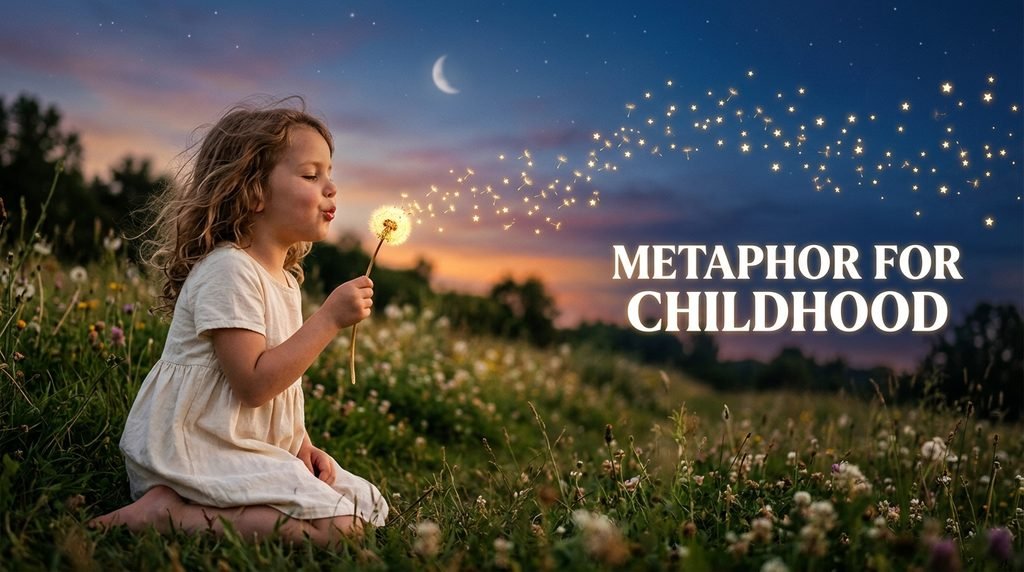
A metaphor for childhood compares childhood to another thing without using “like” or “as.” It gives an idea a stronger image, such as calling childhood “a garden of memories” or “a blank page.” The comparison helps readers feel what childhood was like instead of simply being told about it.
Simple definition
A childhood metaphor is a figurative expression that describes childhood through an imaginative comparison.
For example:
Childhood was a garden full of bright flowers.
This does not mean a child actually lived in a garden. The garden represents happy memories, new experiences, growth, and beauty.
Quick explanation
Metaphors can describe different sides of childhood:
- Innocence: “Childhood was a world of wonder.”
- Freedom: “Childhood was an open sky.”
- Growth: “Childhood was a small seed becoming a tree.”
- Memories: “Childhood was a box of old treasures.”
- Happiness: “Childhood was a sunny morning.”
- Adventure: “Childhood was a treasure hunt.”
- Change: “Childhood was a short season.”
- Learning: “Childhood was a book of first lessons.”
Summary table
| Part | Meaning |
|---|---|
| Metaphor | An imaginative comparison |
| Main subject | Childhood |
| Purpose | To create a clear image or feeling |
| Common themes | Innocence, joy, growth, freedom, memories |
| Common uses | Essays, poems, stories, speeches, captions |
| Example | “Childhood was a garden.” |
| Literal meaning | Childhood is not actually a garden |
| Figurative meaning | Childhood was beautiful, growing, and full of memories |
Why We Use Metaphor for Childhood
Childhood metaphors help people describe feelings that plain words cannot fully capture. They make memories easier to picture and give writing more emotion. A metaphor can turn “my childhood was happy” into “my childhood was a sunny garden,” creating a stronger image for the reader.
Practical purpose
A metaphor can make a simple idea more vivid.
Instead of:
My childhood was full of fun.
You could write:
My childhood was a playground where every day brought a new adventure.
Everyday usage
People use childhood metaphors when talking about old memories, family life, growing up, or the passing of time.
Writing
Metaphors are useful in:
- Personal essays
- Memoirs
- Short stories
- Poems
- Blog posts
- Speeches
- School assignments
Speaking
A simple metaphor can make a personal story sound warmer:
“My childhood was a little world of its own.”
School
Students often use metaphors in creative writing, descriptive essays, poetry, and language exercises.
Social media
Short metaphors work well in captions:
“Childhood was sunshine in a small backyard.”
Professional communication
Metaphors can sometimes work in speeches, presentations, or reflective writing. Keep them clear and avoid overly emotional language in formal business writing.
Main Section
The best childhood metaphor depends on the feeling you want to show. A garden can suggest growth and beauty, while a doorway can suggest change and moving into a new stage of life. Below are 65 original examples with meanings, sentences, uses, limits, alternatives, difficulty, and tone.
1. Childhood Was a Garden
Meaning: A place of growth, beauty, and new experiences.
Real explanation: Children learn and grow just as plants grow in a garden.
Sample sentence: “My childhood was a garden filled with laughter.”
When to use it: Happy or reflective writing.
When NOT to use it: When describing a strongly negative childhood.
Alternatives: Garden of memories; garden of innocence; growing garden.
Difficulty: Easy
Tone: Neutral
2. Childhood Was a Sunrise
Meaning: The bright beginning of life.
Real explanation: Sunrise represents a fresh start, hope, and light.
Sample sentence: “Childhood was the sunrise of my life.”
When to use it: Poetry and reflective writing.
When NOT to use it: Technical writing.
Alternatives: Dawn of life; morning of life; first light.
Difficulty: Easy
Tone: Poetic
3. Childhood Was an Open Book
Meaning: A time filled with new lessons and discoveries.
Real explanation: Children experience many things for the first time.
Sample sentence: “My childhood was an open book, and every day taught me something new.”
When to use it: Essays and stories.
When NOT to use it: When you want to stress freedom rather than learning.
Alternatives: Book of beginnings; first chapter; storybook.
Difficulty: Easy
Tone: Neutral
4. Childhood Was a Blank Page
Meaning: A time before many life experiences shaped a person.
Sample sentence: “Childhood was a blank page waiting for its first story.”
When to use it: Writing about possibilities.
When NOT to use it: When discussing specific memories.
Alternatives: Empty canvas; fresh page; new beginning.
Difficulty: Easy
Tone: Neutral
5. Childhood Was a Playground
Meaning: A time of fun, freedom, and exploration.
Sample sentence: “The neighborhood was our playground.”
When to use it: Happy memories.
When NOT to use it: Serious childhood experiences.
Alternatives: World of play; field of adventure; playland.
Difficulty: Easy
Tone: Informal
6. Childhood Was a Treasure Chest
Meaning: A period filled with valuable memories.
Sample sentence: “My childhood is a treasure chest of small, happy moments.”
When to use it: Memory-based writing.
When NOT to use it: Academic analysis.
Alternatives: Box of memories; memory chest; collection of treasures.
Difficulty: Easy
Tone: Warm
7. Childhood Was a Journey
Meaning: Growing up is a process with many stages.
Sample sentence: “Childhood was a journey of small steps and big discoveries.”
When to use it: Essays and speeches.
When NOT to use it: Very short captions where space is limited.
Alternatives: Growing path; life journey; road of discovery.
Difficulty: Easy
Tone: Neutral
8. Childhood Was a Butterfly
Meaning: Childhood can represent change and transformation.
Sample sentence: “Childhood was a butterfly before it flew into adulthood.”
When to use it: Writing about growing up.
When NOT to use it: When focusing only on innocence.
Alternatives: Young butterfly; changing wings; first flight.
Difficulty: Medium
Tone: Poetic
9. Childhood Was a Small Boat
Meaning: A child begins life before traveling into a larger world.
Sample sentence: “Childhood was a small boat drifting toward the sea of adulthood.”
When to use it: Reflective writing.
When NOT to use it: Simple beginner assignments.
Alternatives: Little vessel; first voyage; young traveler.
Difficulty: Medium
Tone: Poetic
10. Childhood Was a Sunny Morning
Meaning: A bright and happy period of life.
Sample sentence: “Those years were a sunny morning that still warms my memory.”
When to use it: Nostalgic writing.
When NOT to use it: Difficult childhood stories.
Alternatives: Warm morning; bright dawn; golden morning.
Difficulty: Easy
Tone: Warm
11. Childhood Was a House of Wonder
Meaning: A world where ordinary things felt amazing.
Sample sentence: “My childhood was a house of wonder, with every room hiding a new surprise.”
When to use it: Creative writing.
When NOT to use it: Formal reports.
Alternatives: World of wonder; wonderland; magical world.
Difficulty: Medium
Tone: Poetic
12. Childhood Was a Seed
Meaning: Childhood is the beginning of future growth.
Sample sentence: “Childhood was a seed from which my adult life grew.”
When to use it: Writing about personal development.
When NOT to use it: A purely nostalgic caption.
Alternatives: First seed; young plant; beginning of growth.
Difficulty: Easy
Tone: Neutral
13. Childhood Was a Candle Flame
Meaning: A small, bright period that can be remembered later.
Sample sentence: “Childhood was a candle flame glowing in the dark rooms of memory.”
When to use it: Emotional poetry.
When NOT to use it: Casual conversation.
Alternatives: Little flame; warm light; childhood glow.
Difficulty: Medium
Tone: Poetic
14. Childhood Was a Kite
Meaning: Freedom, play, and imagination.
Sample sentence: “Childhood was a kite dancing freely in the afternoon sky.”
When to use it: Poems and captions.
When NOT to use it: Formal writing.
Alternatives: Flying kite; open sky; free spirit.
Difficulty: Easy
Tone: Poetic
15. Childhood Was a Summer
Meaning: A warm, enjoyable, and memorable stage of life.
Sample sentence: “Childhood was the summer of my life.”
When to use it: Nostalgia.
When NOT to use it: When describing a short specific event.
Alternatives: Golden summer; warm season; summer days.
Difficulty: Easy
Tone: Poetic
16. Childhood Was a Safe Harbor
Meaning: A place or period that offered comfort and protection.
Sample sentence: “My childhood home was a safe harbor from the outside world.”
When to use it: Family-centered writing.
When NOT to use it: If the childhood was unsafe.
Alternatives: Safe haven; shelter; quiet harbor.
Difficulty: Medium
Tone: Warm
17. Childhood Was a Little Universe
Meaning: Children can see their small world as complete and exciting.
Sample sentence: “Our backyard was a little universe of its own.”
When to use it: Memory writing.
When NOT to use it: Formal essays.
Alternatives: Tiny world; private universe; small world.
Difficulty: Easy
Tone: Poetic
18. Childhood Was a Magic Carpet
Meaning: Imagination made ordinary life feel magical.
Sample sentence: “Our old blanket became a magic carpet in childhood.”
When to use it: Stories and creative writing.
When NOT to use it: Professional writing.
Alternatives: Magical journey; dream world; flying carpet.
Difficulty: Medium
Tone: Playful
19. Childhood Was a Dream
Meaning: Childhood may feel distant, beautiful, or unreal when remembered.
Sample sentence: “Those childhood summers now seem like a dream.”
When to use it: Nostalgia.
When NOT to use it: When precise facts are needed.
Alternatives: Sweet dream; distant dream; waking dream.
Difficulty: Easy
Tone: Emotional
20. Childhood Was a Photograph
Meaning: A memory preserved in the mind.
Sample sentence: “That little house remains a photograph in my memory.”
When to use it: Reflective writing.
When NOT to use it: When discussing growth.
Alternatives: Snapshot of youth; memory picture; old photograph.
Difficulty: Easy
Tone: Neutral
21. Childhood Was a Storybook
Meaning: Life felt full of stories, imagination, and adventure.
Sample sentence: “My childhood felt like a storybook with a new adventure every week.”
When to use it: Creative writing.
When NOT to use it: Serious academic work.
Alternatives: Fairy tale; storybook world; childhood tale.
Difficulty: Easy
Tone: Playful
22. Childhood Was a Doorway
Meaning: Childhood leads into later stages of life.
Sample sentence: “Childhood was a doorway into the wider world.”
When to use it: Writing about transition.
When NOT to use it: A simple happy-memory caption.
Alternatives: Gateway; entrance; first door.
Difficulty: Medium
Tone: Neutral
23. Childhood Was a Map
Meaning: Early experiences can help shape later life.
Sample sentence: “Childhood became a map for many choices I made later.”
When to use it: Reflective essays.
When NOT to use it: When talking only about fun.
Alternatives: Life map; first guide; road map.
Difficulty: Medium
Tone: Neutral
24. Childhood Was a Seedbed
Meaning: A place where ideas, habits, and values begin to grow.
Sample sentence: “My childhood was a seedbed for my love of books.”
When to use it: Educational writing.
When NOT to use it: Casual captions.
Alternatives: Ground for growth; starting ground; fertile ground.
Difficulty: Medium
Tone: Formal
25. Childhood Was a Nest
Meaning: A protected place before moving into independence.
Sample sentence: “Home was my childhood nest.”
When to use it: Family memories.
When NOT to use it: If protection is not the main idea.
Alternatives: Safe nest; family shelter; warm home.
Difficulty: Easy
Tone: Warm
26. Childhood Was a Little Kingdom
Meaning: Children can feel that their small world belongs entirely to them.
Sample sentence: “The backyard was our little kingdom.”
When to use it: Playful memories.
When NOT to use it: Formal writing.
Alternatives: Small kingdom; child’s world; private realm.
Difficulty: Medium
Tone: Playful
27. Childhood Was a River
Meaning: Childhood moves forward and cannot be stopped.
Sample sentence: “Childhood was a river carrying us toward adulthood.”
When to use it: Reflective writing.
When NOT to use it: Very simple beginner work.
Alternatives: Flow of youth; life stream; flowing years.
Difficulty: Medium
Tone: Poetic
28. Childhood Was a Passing Cloud
Meaning: Childhood disappears quickly.
Sample sentence: “Childhood was a passing cloud, beautiful but brief.”
When to use it: Nostalgic writing.
When NOT to use it: When emphasizing long-lasting memories.
Alternatives: Passing season; fleeting moment; drifting cloud.
Difficulty: Medium
Tone: Poetic
29. Childhood Was a Playground of Dreams
Meaning: Children have active imaginations and big hopes.
Sample sentence: “The old neighborhood was a playground of dreams.”
When to use it: Creative essays.
When NOT to use it: Formal reports.
Alternatives: World of dreams; field of imagination; dreamland.
Difficulty: Medium
Tone: Poetic
30. Childhood Was a Blank Canvas
Meaning: A young life has many possible directions.
Sample sentence: “Childhood was a blank canvas waiting for color.”
When to use it: Writing about possibility.
When NOT to use it: When discussing specific memories.
Alternatives: Empty canvas; fresh canvas; new picture.
Difficulty: Easy
Tone: Neutral
31. Childhood Was a First Chapter
Meaning: Childhood begins a person’s larger life story.
Sample sentence: “Childhood was only the first chapter of my story.”
When to use it: Essays and speeches.
When NOT to use it: Very casual speech.
Alternatives: Opening chapter; beginning; first page.
Difficulty: Easy
Tone: Neutral
32. Childhood Was a Pocket Full of Stars
Meaning: Childhood can hold many bright, precious memories.
Sample sentence: “I carry childhood like a pocket full of stars.”
When to use it: Poetry and captions.
When NOT to use it: Business communication.
Alternatives: Pocket of memories; handful of stars; little lights.
Difficulty: Medium
Tone: Poetic
33. Childhood Was a Box of Colors
Meaning: Childhood contains many different feelings and experiences.
Sample sentence: “My childhood was a box of colors, from bright joy to quiet sadness.”
When to use it: Reflective writing.
When NOT to use it: Strictly factual writing.
Alternatives: Colorful years; palette of memories; rainbow of moments.
Difficulty: Medium
Tone: Creative
34. Childhood Was a Clock Without Hands
Meaning: Children often feel less aware of time passing.
Sample sentence: “Summer days felt like a clock without hands.”
When to use it: Nostalgic writing.
When NOT to use it: If the focus is growth.
Alternatives: Timeless days; endless afternoon; frozen time.
Difficulty: Medium
Tone: Poetic
35. Childhood Was a Paper Boat
Meaning: Childhood can be simple, fragile, and full of adventure.
Sample sentence: “Our paper boats carried our childhood dreams down the stream.”
When to use it: Poetry and creative stories.
When NOT to use it: Professional communication.
Alternatives: Tiny boat; little voyage; fragile ship.
Difficulty: Medium
Tone: Poetic
36. Childhood Was a Firefly
Meaning: Childhood memories can be small but bright.
Sample sentence: “Each childhood memory is a firefly lighting up the past.”
When to use it: Emotional writing.
When NOT to use it: Formal school reports.
Alternatives: Little light; glowing memory; tiny star.
Difficulty: Medium
Tone: Poetic
37. Childhood Was a Tree
Meaning: Early life provides roots for later growth.
Sample sentence: “Childhood was the tree whose roots still hold my memories.”
When to use it: Personal essays.
When NOT to use it: Simple captions.
Alternatives: Deep roots; growing tree; life roots.
Difficulty: Easy
Tone: Reflective
38. Childhood Was a Bridge
Meaning: Childhood connects early life with adulthood.
Sample sentence: “Childhood was the bridge between dependence and independence.”
When to use it: School or reflective writing.
When NOT to use it: Lighthearted memories.
Alternatives: Life bridge; passage; crossing point.
Difficulty: Medium
Tone: Formal
39. Childhood Was a Compass
Meaning: Early lessons can guide later choices.
Sample sentence: “My parents’ lessons became a compass during adulthood.”
When to use it: Personal development writing.
When NOT to use it: When describing only fun.
Alternatives: Inner compass; early guide; direction.
Difficulty: Medium
Tone: Neutral
40. Childhood Was a Field of Wildflowers
Meaning: Childhood can be natural, free, colorful, and unpredictable.
Sample sentence: “My childhood was a field of wildflowers, messy but beautiful.”
When to use it: Creative writing.
When NOT to use it: Formal business writing.
Alternatives: Wild garden; field of color; free garden.
Difficulty: Medium
Tone: Poetic
41. Childhood Was a Warm Blanket
Meaning: Childhood memories can provide comfort.
Sample sentence: “Her childhood memories were a warm blanket on difficult days.”
When to use it: Emotional writing.
When NOT to use it: When childhood itself was difficult.
Alternatives: Comforting memory; soft shelter; warm memory.
Difficulty: Easy
Tone: Warm
42. Childhood Was a Music Box
Meaning: Childhood memories can replay in the mind.
Sample sentence: “My childhood is a music box that still plays in my memory.”
When to use it: Poetry and memoirs.
When NOT to use it: Formal reports.
Alternatives: Memory song; old melody; childhood tune.
Difficulty: Medium
Tone: Poetic
43. Childhood Was a Train Station
Meaning: Childhood is a place from which life moves into new stages.
Sample sentence: “Childhood was the station where the train of life first began to move.”
When to use it: Reflective essays.
When NOT to use it: Simple school definitions.
Alternatives: Starting station; first stop; life station.
Difficulty: Medium
Tone: Poetic
44. Childhood Was a Window
Meaning: Childhood offers a way of seeing the world with fresh eyes.
Sample sentence: “Childhood was a window through which everything looked new.”
When to use it: Creative writing.
When NOT to use it: When emphasizing growth.
Alternatives: Fresh window; new view; clear window.
Difficulty: Easy
Tone: Neutral
45. Childhood Was a Lighthouse
Meaning: Childhood memories or lessons can guide a person later.
Sample sentence: “Her grandmother’s lessons became a lighthouse in adulthood.”
When to use it: Reflective writing.
When NOT to use it: If there was no guiding influence.
Alternatives: Guiding light; beacon; childhood light.
Difficulty: Medium
Tone: Formal
46. Childhood Was a Field Trip
Meaning: Childhood is a period of exploration and discovery.
Sample sentence: “Every trip outside the neighborhood felt like a field trip.”
When to use it: Happy memories.
When NOT to use it: Serious reflection.
Alternatives: Adventure; exploration; discovery tour.
Difficulty: Easy
Tone: Informal
47. Childhood Was a Puzzle
Meaning: Children learn how different parts of life fit together.
Sample sentence: “Childhood was a puzzle made from small lessons and big questions.”
When to use it: Learning-focused writing.
When NOT to use it: Pure nostalgia.
Alternatives: Life puzzle; collection of pieces; growing puzzle.
Difficulty: Easy
Tone: Neutral
48. Childhood Was a Backpack
Meaning: Childhood experiences are carried into later life.
Sample sentence: “We carry childhood in a backpack of memories.”
When to use it: Reflective writing.
When NOT to use it: Formal definitions.
Alternatives: Memory bag; emotional baggage; life pack.
Difficulty: Medium
Tone: Neutral
49. Childhood Was a Seed of Hope
Meaning: Early dreams can grow into future goals.
Sample sentence: “That childhood dream was a seed of hope.”
When to use it: Inspirational writing.
When NOT to use it: When discussing ordinary memories.
Alternatives: Seed of dreams; first hope; young dream.
Difficulty: Easy
Tone: Inspirational
50. Childhood Was a Hidden Treasure
Meaning: Old memories can become more valuable over time.
Sample sentence: “Those simple afternoons are hidden treasures now.”
When to use it: Nostalgia.
When NOT to use it: Academic writing.
Alternatives: Buried treasure; precious memory; lost treasure.
Difficulty: Easy
Tone: Warm
51. Childhood Was a Rainbow
Meaning: Childhood can contain many colors, moods, and memories.
Sample sentence: “My childhood was a rainbow of laughter, games, and family trips.”
When to use it: Positive writing.
When NOT to use it: A deeply serious context.
Alternatives: Colorful years; rainbow of memories; bright colors.
Difficulty: Easy
Tone: Cheerful
52. Childhood Was a Cloud of Imagination
Meaning: Children often live in a rich world of imagination.
Sample sentence: “He spent his childhood inside a cloud of imagination.”
When to use it: Creative writing.
When NOT to use it: Formal essays.
Alternatives: World of imagination; dream cloud; imaginative world.
Difficulty: Medium
Tone: Poetic
53. Childhood Was a Door Left Open
Meaning: Childhood can represent freedom and possibility.
Sample sentence: “Childhood was a door left open to endless possibilities.”
When to use it: Inspirational writing.
When NOT to use it: Negative childhood stories.
Alternatives: Open doorway; world of possibility; open path.
Difficulty: Easy
Tone: Inspirational
54. Childhood Was a Little Adventure
Meaning: Ordinary days can feel exciting to children.
Sample sentence: “Walking to the corner store was a little adventure.”
When to use it: Casual writing.
When NOT to use it: Formal academic writing.
Alternatives: Small adventure; daily adventure; young adventure.
Difficulty: Easy
Tone: Informal
55. Childhood Was a Garden Path
Meaning: Childhood is an early path toward future growth.
Sample sentence: “Childhood was the garden path that led me toward adulthood.”
When to use it: Reflective essays.
When NOT to use it: Casual conversation.
Alternatives: Growing path; life path; early road.
Difficulty: Medium
Tone: Poetic
56. Childhood Was a Candle in the Window
Meaning: Childhood can represent warmth, home, and belonging.
Sample sentence: “The old house remains a candle in the window of my memory.”
When to use it: Family memories.
When NOT to use it: Professional writing.
Alternatives: Home light; warm memory; guiding light.
Difficulty: Medium
Tone: Poetic
57. Childhood Was a Circle of Laughter
Meaning: Childhood was centered on friendship and shared joy.
Sample sentence: “Our afternoons were a circle of laughter.”
When to use it: Friendship memories.
When NOT to use it: Solitary childhood stories.
Alternatives: Ring of laughter; joyful world; laughter-filled years.
Difficulty: Easy
Tone: Warm
58. Childhood Was a Little Cloud
Meaning: Childhood can feel soft, distant, and dreamlike.
Sample sentence: “My childhood now feels like a little cloud floating across memory.”
When to use it: Nostalgic poetry.
When NOT to use it: Clear factual writing.
Alternatives: Dream cloud; soft memory; distant cloud.
Difficulty: Medium
Tone: Poetic
59. Childhood Was a House of Firsts
Meaning: Childhood contains many first experiences.
Sample sentence: “Childhood was a house of firsts: first friend, first bike, and first big dream.”
When to use it: Essays and speeches.
When NOT to use it: Very formal reports.
Alternatives: World of firsts; first experiences; beginning years.
Difficulty: Easy
Tone: Neutral
60. Childhood Was a Road of Discovery
Meaning: Children learn about themselves and the world through experience.
Sample sentence: “Childhood was a road of discovery with a new lesson around every corner.”
When to use it: School assignments.
When NOT to use it: When describing only memories.
Alternatives: Path of discovery; road of learning; journey of discovery.
Difficulty: Easy
Tone: Neutral
61. Childhood Was a Golden Hour
Meaning: A precious period remembered with warmth.
Sample sentence: “Those afternoons were the golden hour of my childhood.”
When to use it: Nostalgic writing.
When NOT to use it: Literal descriptions.
Alternatives: Golden days; precious time; bright years.
Difficulty: Medium
Tone: Poetic
62. Childhood Was a Garden of Dreams
Meaning: Childhood can be full of hopes and imagination.
Sample sentence: “Her childhood was a garden of dreams waiting to bloom.”
When to use it: Inspirational writing.
When NOT to use it: Technical writing.
Alternatives: Garden of hopes; field of dreams; world of dreams.
Difficulty: Easy
Tone: Inspirational
63. Childhood Was a Story in the Sand
Meaning: Childhood memories can be beautiful but temporary.
Sample sentence: “Childhood was a story in the sand, slowly changed by time.”
When to use it: Writing about memories and time.
When NOT to use it: Positive-only descriptions.
Alternatives: Sand-written story; fading memory; temporary tale.
Difficulty: Medium
Tone: Poetic
64. Childhood Was a Starry Sky
Meaning: Childhood can represent wonder, dreams, and endless possibility.
Sample sentence: “Childhood was a starry sky filled with impossible dreams.”
When to use it: Poems and inspirational captions.
When NOT to use it: Formal reports.
Alternatives: Sky of dreams; field of stars; night of wonder.
Difficulty: Easy
Tone: Poetic
65. Childhood Was a Door That Closed Too Soon
Meaning: Childhood can feel short when remembered later.
Sample sentence: “Childhood was a door that closed too soon, leaving memories behind.”
When to use it: Bittersweet writing.
When NOT to use it: When discussing a joyful childhood without sadness.
Alternatives: Passing childhood; short season; quickly closed door.
Difficulty: Medium
Tone: Emotional
Real-Life Conversations
1. Friends
Sara: Do you ever miss being a kid?
Mia: All the time.
Sara: What do you miss most?
Mia: The freedom. Childhood was a playground to me. We could spend all afternoon outside.
Sara: Same. We thought those days would last forever.
2. Family
Son: Mom, why do you keep old pictures?
Mom: They remind me of your childhood.
Son: Do you miss it?
Mom: Sometimes. Those years were a little garden of memories.
3. Student and Teacher
Student: Can I say “childhood was a garden” in my essay?
Teacher: Yes. Explain what the garden represents.
Student: Growth, happiness, and new experiences.
Teacher: Good. That makes the metaphor clear.
4. Office Conversation
I’m writing a speech about growing up.
You could describe childhood as the first chapter of life.
I like that. It sounds simple but meaningful.
Exactly. Just explain the comparison.
5. Social Media
Aisha: What caption are you using for that old photo?
Noor: “Childhood was a pocket full of stars.”
Aisha: That’s sweet.
Noor: It fits the picture. We were always outside together.
Everyday Usage
Childhood metaphors work best when the image matches the feeling. A simple metaphor is often stronger than a complicated one.
Conversation
Use easy expressions such as:
“Childhood was a playground.”
“Those years were a sunny morning.”
These sound natural and are easy to understand.
Writing
In essays, explain the metaphor after using it:
“Childhood was a garden. Each new experience was like a seed that helped shape who I became.”
This makes the comparison clear.
Books
Authors often use metaphors to show a character’s memories, growth, fears, or hopes without explaining every feeling directly.
Movies
A character may describe childhood as a “lost summer” or “first chapter” to show that the past still affects the present.
Poetry
Poetry allows more imaginative metaphors:
“Childhood was a firefly trapped in the jar of memory.”
Emails
Use metaphors carefully in professional emails. A simple phrase may work in a personal message, but formal business emails usually benefit from direct language.
Text messages
Short metaphors are useful:
“Those days were pure sunshine.”
Caption-style metaphors can be brief:
“A little universe called childhood.”
Longer nostalgic posts can use several related images, but avoid filling every sentence with a metaphor.
X
Short expressions work best:
“Childhood: a tiny world with endless skies.”
Keep the language professional:
“Childhood was the first chapter of my learning journey.”
School assignments
A clear metaphor followed by an explanation is usually the safest approach:
“Childhood was a blank canvas because every new experience added something to who I became.”
How to Choose the Right Childhood Metaphor
Choose the metaphor based on the exact emotion you want the reader to feel.
A useful rule is:
Feeling → Image → Metaphor
For example:
- Happiness → sunshine → “Childhood was a sunny morning.”
- Growth → seed → “Childhood was a seed.”
- Freedom → kite → “Childhood was a kite.”
- Memories → treasure → “Childhood was a treasure chest.”
- Imagination → storybook → “Childhood was a storybook.”
- Change → butterfly → “Childhood was a butterfly.”
- Guidance → compass → “Childhood was a compass.”
Common Mistakes to Avoid
1. Mixing metaphors
Avoid combining unrelated images in one sentence:
“Childhood was a garden that sailed through the sky and opened a book.”
The images compete with each other.
2. Explaining too much
A strong metaphor does not need five sentences of explanation.
3. Choosing a metaphor that does not match the feeling
A “safe harbor” suggests protection. Do not use it when your main idea is freedom.
4. Using clichés too often
Common metaphors can still work, but a fresh image may make personal writing more memorable.
5. Forgetting the audience
A poetic metaphor may work beautifully in a poem but sound strange in a business report.
Final Takeaway:
A metaphor for childhood turns a simple idea about growing up into a clear and memorable image. The best choice depends on what you want to express.
Use a garden for growth, a playground for fun, a kite for freedom, a treasure chest for memories, a seed for development, a storybook for imagination, or a passing cloud for the shortness of childhood.
Keep the language natural, make the comparison easy to understand, and choose an image that fits the emotion.
A good childhood metaphor does not merely tell readers what childhood was; it helps them see, feel, and remember it.
Discover more post:
| https://metaphorcraftz.com/a-metaphor-for-school/ |
| https://metaphorcraftz.com/metaphor-for-something-shiny/ |
| https://metaphorcraftz.com/metaphor-for-shattered-glass/ |
Liora is a passionate writer, language enthusiast, and experienced content creator with 5 years of experience researching and writing about metaphors, figurative language, literary devices, symbolism, and the deeper meanings behind everyday words and expressions.
Related Post
A Metaphor for School: Creative Examples, Meanings
Search intent: People searching for “a metaphor for school” usually want creative ways to describe…
3 thoughts on “Metaphor for Childhood: Creative Examples and Their Meanings”